Vehicle recovery winch angles are the directions and geometry of a pull relative to the recovery vehicle, the stuck vehicle, and the winch line. Managing those angles helps reduce side loading, line damage, uncontrolled movement, and the risk of a cable or synthetic rope breaking under tension. A safe recovery starts by checking the equipment’s working load limits, choosing a stable anchor, keeping the line as straight as practical, and controlling the recovery zone. The guidance below explains pull geometry, line capacity, rigging choices, and operating practices, drawing on manufacturer instructions and recognized off-road safety guidance. No single angle or setup makes a recovery automatically safe: load, equipment condition, terrain, and the vehicle’s stability all matter.
Winch pull angles and recovery geometry
A winch pull angle describes the direction the winch line travels from the winch drum toward its anchor or load. It has two practical components: the horizontal angle, viewed from above, and the vertical angle, viewed from the side. Warn Industries’ winch instructions caution operators to use the fairlead as intended and avoid pulling at an angle that causes the line to rub against the fairlead or drum. The central safety principle is to keep the line aligned with the winch and its fairlead, while positioning the recovery vehicle and anchor so the force does not destabilize either vehicle.
Angle matters because a winch applies force along the line, not necessarily in the direction the vehicle should travel. A sideways pull can steer or roll a vehicle, shift an anchor, or cause the line to spool unevenly. A steep upward or downward pull can add leverage that changes vehicle stability and puts unusual loads on mounting points. These effects depend on the terrain and rigging; there is no universal “safe angle” that substitutes for the winch and vehicle manufacturer’s limits.
Horizontal angle and fairlead alignment
Horizontal angle is the line’s left-to-right deviation from the winch’s centerline. When a line pulls sharply to one side, it may bunch at one edge of the drum, rub on the fairlead, or apply a sideways force to the vehicle. If the pull is not reasonably aligned, reposition the recovery vehicle or use an appropriate redirect pulley and rated rigging, following the equipment maker’s instructions. A pulley changes the direction of the line; it does not erase the force on the anchor or make an overloaded component safe.
Vertical angle and vehicle stability
Vertical angle is the line’s upward or downward slope between winch and load. A high or low line can affect suspension, traction, and the tendency of a vehicle to pitch or tip, especially on uneven ground or near an edge. Keep people clear of the line path and avoid arrangements that could lift, drag, or overturn a vehicle unexpectedly. Consult the winch, vehicle, and recovery-point manufacturers when a pull requires a substantial vertical deviation.
Cable and rope capacity in vehicle recovery
Cable capacity is the rated ability of a wire rope, synthetic winch line, winch, recovery point, or connector to withstand specified loads under stated conditions. These ratings are not interchangeable: the full system is limited by its weakest component, and a rating may depend on how the equipment is installed and used. The U.S. Occupational Safety and Health Administration’s general rigging guidance emphasizes inspecting equipment and not exceeding rated capacities; vehicle-recovery operators should likewise follow the exact winch and accessory manuals rather than estimate strength by appearance.
Winch ratings commonly refer to a maximum line pull under specified conditions, often with the first layer of rope on the drum. As more line layers build up, effective pulling capacity can decrease. Actual demand also changes with slope, mud or sand resistance, obstacles, and whether the load is moving or stuck. The American Automobile Association and recovery-equipment manufacturers advise using rated, purpose-built gear and avoiding shock loading. A dynamic jerk can create forces well above a steady pull, so kinetic recovery straps should not be substituted for a winch line unless the product is specifically designed and rated for that use.
Working load limits and weakest-link checks
A working load limit (WLL) is the maximum load a component is designed to handle in its intended service, as specified by its manufacturer or applicable standard. Before a pull, verify the ratings of the winch, line, recovery points, shackles, tree protector, and any snatch block. Do not assume that a vehicle’s tow hook is a recovery point, or that a visually similar shackle has the same capacity as a rated recovery connector. Replace damaged, corroded, kinked, abraded, or otherwise suspect equipment according to the manufacturer’s criteria.
Drum layers, line condition, and inspection
The winch drum stores line in layers, and the number of layers affects the mechanical advantage and rated pull available at the line. Keep the line properly spooled under tension and follow the manual for minimum wraps on the drum; never rely on a single wrap or an improvised knot to retain the load. Inspect wire rope for broken wires, crushing, corrosion, bird-caging, and kinks. Inspect synthetic rope for cuts, glazing, abrasion, contamination, and damaged splices. A damaged line can fail even when the pull angle appears correct.
Winch rigging methods for safer pull angles
Rigging methods are ways of arranging the line, anchor, and accessories to direct a pull while keeping loads within equipment limits. The simplest method is a straight, single-line pull from a stable anchor to a rated recovery point. When the winch vehicle cannot align with the load, a rated snatch block can redirect the line, but the block and anchor then experience forces that must be checked against their ratings. Any change in geometry should be treated as a change in load path, not as a shortcut around capacity limits.
Single-line pull
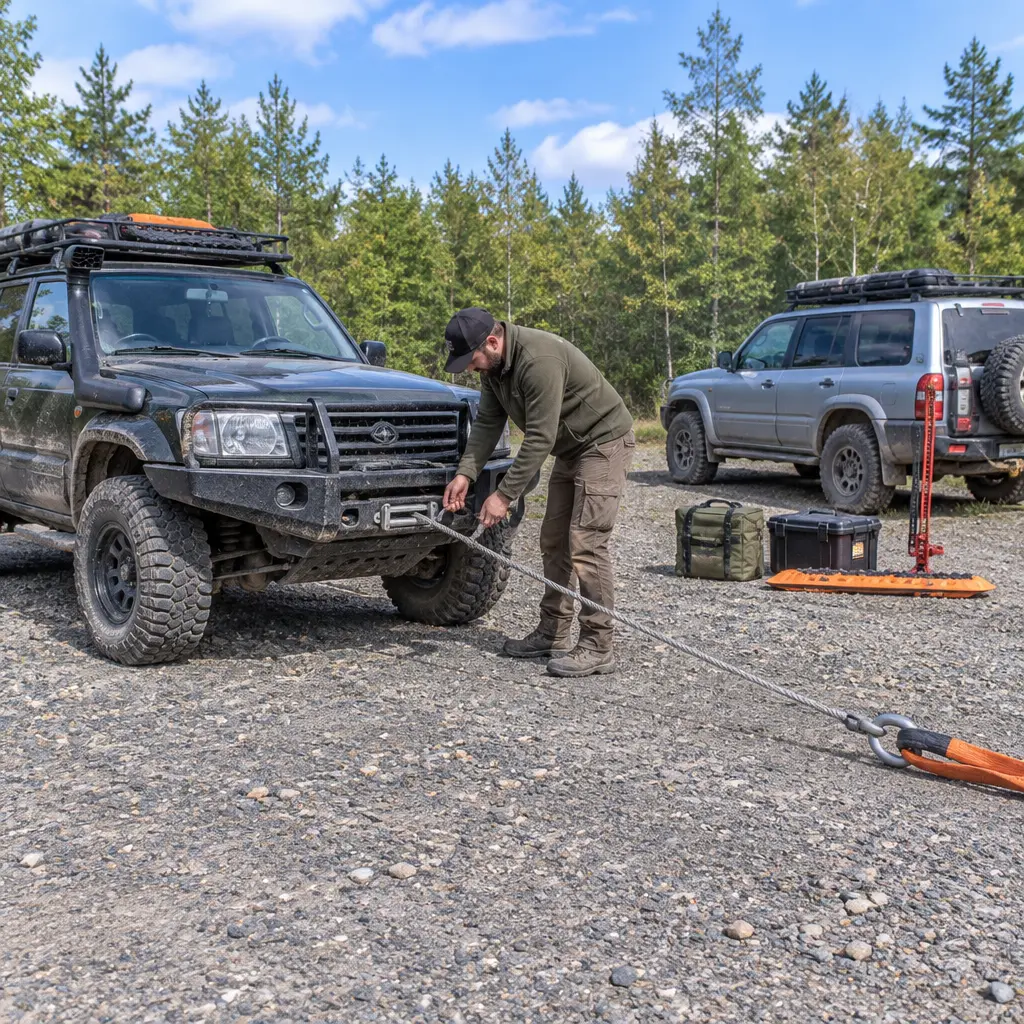
A single-line pull runs from the winch to the load or anchor without a redirect. It is usually the simplest arrangement to inspect and communicate. Align the winch vehicle with the pull, select an anchor that cannot shift or fail, and connect only to manufacturer-approved recovery points. If the line would have to run across a sharp edge or contact a body panel, stop and revise the setup rather than allowing abrasion or side loading.
Snatch-block redirects and double-line pulls
A snatch block is a pulley designed for recovery or lifting applications, used to redirect a line or create a multi-part pull. A redirect can improve alignment, and a properly configured double-line pull can reduce the load demanded of the winch line while increasing the load on the anchor and block. The exact forces depend on the angles between line sections and friction in the system. Use only rated equipment, secure the block according to its manual, and calculate or obtain qualified guidance for complex setups. Do not stand inside the angle formed by loaded line sections.
Anchors, trees, and recovery points
An anchor is the structure that resists the pull. Suitable anchors may include a purpose-built ground anchor or a sound tree used with a correctly rated tree-protection strap, where local rules and environmental conditions permit. Never wrap a winch line directly around a tree; it can damage the tree and the line may slip or be crushed. Avoid anchoring to another vehicle unless its recovery point, brakes, position, and operator are suitable for the expected load. Inspect the anchor’s footing and surrounding ground because soil failure can release the load suddenly.
Cable snap hazards and recovery-zone control
A cable snap hazard is the risk that a loaded wire rope, synthetic line, connector, or anchor fails and releases stored energy. The failure may send line or hardware moving unpredictably, while the vehicle can also lurch or roll. The U.S. Bureau of Labor Statistics tracks severe workplace injuries and fatalities involving struck-by incidents, but its broad categories do not provide a reliable, vehicle-winch-specific failure rate. Accordingly, safety decisions should be based on equipment ratings, inspection, controlled operation, and keeping people out of danger areas—not on an assumed probability that a line will or will not break.
Exclusion zones and line dampers
An exclusion zone is the area kept clear of bystanders during a loaded pull. Keep everyone away from the line, the space between vehicles, the anchor, and the likely path of a released component. Operate the winch from a position recommended by its manufacturer, using a remote control where provided. A line damper or purpose-made blanket may help reduce some line movement if a failure occurs, but it cannot make standing near a loaded line safe or guarantee that all hardware will remain contained. Warn and move bystanders before tensioning the system.
Controlled tension and communication
Controlled tension means applying load gradually and stopping to check alignment, anchor stability, and spooling. Agree on clear signals before starting, assign one person to direct the operation, and ensure the driver can stop immediately. Keep hands away from the drum, fairlead, and moving line. Do not use a winch to lift people, and do not exceed duty-cycle limits; winch motors and electrical systems can overheat during prolonged operation.
A practical angle-and-rigging checklist
Use this checklist as a prompt, not as a replacement for the equipment manuals or professional training:
- Assess the stuck vehicle, terrain, likely direction of travel, and hazards such as slopes, traffic, water, or unstable ground.
- Confirm that the winch, line, anchor, recovery points, connectors, and any pulley are rated for the intended use and are in serviceable condition.
- Choose the straightest practical line path. Reposition the vehicle or use a correctly rated redirect if the line would rub, spool badly, or create a destabilizing side pull.
- Check both horizontal and vertical geometry, the stability of each vehicle, and the load path through every component.
- Clear the exclusion zone, communicate the plan, and apply tension gradually while monitoring the line, drum, anchor, and vehicle movement.
- Stop immediately if the line shifts, the anchor moves, equipment deforms, the vehicle becomes unstable, or anyone enters the danger area.
Conclusion: safer recovery through deliberate winch angles
Winch pull angles, cable capacity, rigging geometry, and recovery-zone control are linked parts of a safe vehicle recovery. Keep the line aligned with the winch and fairlead where practical, avoid unapproved side or vertical loading, verify the ratings of the entire system, and treat snatch blocks and anchors as load-bearing components. Inspect equipment, prevent shock loading, communicate clearly, and keep everyone out of the line of fire. Before the next recovery, read the relevant manuals and consider hands-on training from a qualified off-road recovery instructor; when the load or setup is uncertain, stop and seek expert help.
Sources: Warn Industries, WARN Winch Operator’s Manual and Safety Information, https://www.warn.com/; U.S. Occupational Safety and Health Administration, 29 CFR 1910.184 — Slings, https://www.osha.gov/laws-regs/regulations/standardnumber/1910/1910.184; American Automobile Association, Off-Road Driving Safety, https://exchange.aaa.com/safety/roadway-safety/off-road-driving/; U.S. Bureau of Labor Statistics, Injuries, Illnesses, and Fatalities, https://www.bls.gov/iif/